

How to connect Aras PLM and Odoo ERP to create a robust Digital Thread.
Why Connect Aras PLM With Odoo ERP?
For many engineering‑driven manufacturers, PLM and ERP form the backbone of their product development and business execution stack. Aras excels at managing product data, requirements, configurations, and engineering change throughout the lifecycle, while Odoo provides flexible, modular capabilities for inventory, purchasing, manufacturing, and finance. When these two platforms operate in isolation, however, you end up with duplicated part masters, out‑of‑sync BOMs, and manual re‑entry of changes; exactly the opposite of what a Digital Thread is supposed to deliver.
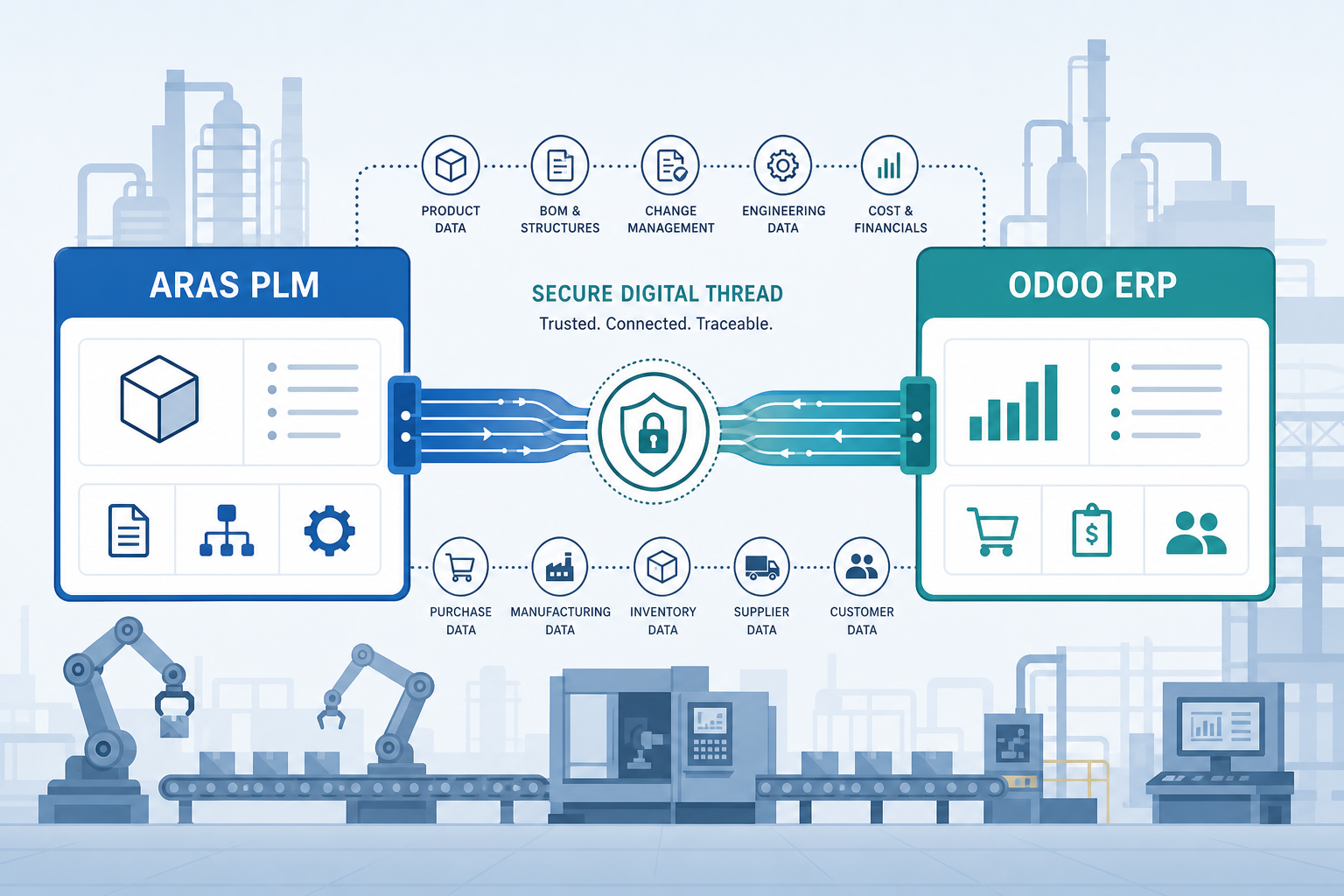
The goal of integrating Aras PLM with Odoo ERP is to establish a single, trusted flow of product information from concept through production and into operations. Instead of treating integration as a one‑time data migration, leading manufacturers define a continuous synchronization model. As described by Rockwell Automation in their discussion of Digital Thread for the connected enterprise: Rockwell Automation digital thread overview, the most resilient Digital Threads are those that continuously connect design, manufacturing, and maintenance systems so each decision is made on current, consistent data.
From a business perspective, a well‑designed Aras–Odoo integration reduces order errors, shortens engineering change lead times, and improves traceability. Planners no longer need to guess which revision of a BOM is current, and engineers receive timely feedback about how products perform in the field. Technically, this requires more than a simple file export; you need a governed integration architecture that can handle complex product structures, variant rules, and incremental changes over time.
Key Integration Patterns and Data Flows to Align PLM and ERP
At a high level, integrating Aras PLM and Odoo ERP means agreeing on how product definitions, changes, and status updates move between systems without duplication or conflict. The safest approach is to treat PLM as the “system of record” for product definition and engineering change, while ERP serves as the “system of record” for planning, costing, and execution. That philosophy drives which integration patterns and data flows you implement.
A foundational building block is item and BOM synchronization. In a typical pattern, engineering defines parts, documents, and structures in Aras; once a design reaches a specific maturity state (for example, “Released to Manufacturing”), an integration service publishes the associated items and BOMs to Odoo as products and multi‑level manufacturing BOMs.
Change management is the next critical flow. Engineering change requests and change orders originate and are approved in Aras. Once approved, the integration should automatically propagate the resulting BOM deltas, effectivity dates, and impacted items into Odoo. This ensures that production orders, purchasing, and inventory in Odoo always reflect the latest approved design without planners having to re‑key data. The Aras community has documented the importance of robust PLM connectors for Digital Thread continuity, as highlighted in this Aras blog on PLM connectors.
Finally, you need supporting flows for reference data and feedback. On the reference side, Odoo may own vendors, lead times, and costing; those attributes can be selectively synchronized back into Aras so engineers make decisions using realistic supply‑chain data. On the feedback side, Odoo can send quality metrics, scrap rates, and field failure data into Aras, enriching the Digital Thread and closing the loop from design to operation. Together, these patterns give each system a clear role while keeping them in constant alignment.
Roadmap to a Connected Aras–Odoo Landscape
Connecting Aras and Odoo is as much an organizational change as it is a technical project, so a phased roadmap is essential. The first phase usually focuses on integration foundations: defining your data model mapping, selecting or implementing an integration framework, and agreeing on governance. This is where partnering with a team that understands both environments pays off. Intrepid’s own Enterprise Solutions practice, outlined here: Intrepid enterprise integration services, is built around unifying CAD, Aras Innovator, and Odoo ERP into a single Digital Thread from concept to delivery.
Once the foundation is in place, you can roll out item and BOM synchronization for a limited product family. Use this pilot to validate field mappings, error handling, and user experience on both sides. For example, ensure that engineers in Aras see a clear indicator when a part has been published to Odoo and that planners in Odoo can easily trace each product back to its engineering definition. During this phase you should also establish monitoring dashboards and alerts so integration failures are detected before they impact production.
The next phase expands the scope to include full change management and selected feedback loops. Introduce automated propagation of approved changes from Aras to Odoo, starting with low‑risk components and gradually increasing coverage. At the same time, bring targeted operational data—such as non‑conformance reports or service bulletins—from Odoo back into Aras as inputs to design improvement. Over time, you can extend the integration to cover additional systems such as MES, QMS, or CPQ, further enriching the Digital Thread.
Throughout every phase, invest in training and communication. Engineers, planners, buyers, and operations leaders need to understand which system owns which data and how the integration changes their daily work. Clear ownership, well‑documented processes, and strong executive sponsorship will help you move beyond a one‑off sync project toward a resilient, upgrade‑friendly integration landscape that supports your long‑term Digital Transformation strategy.
