


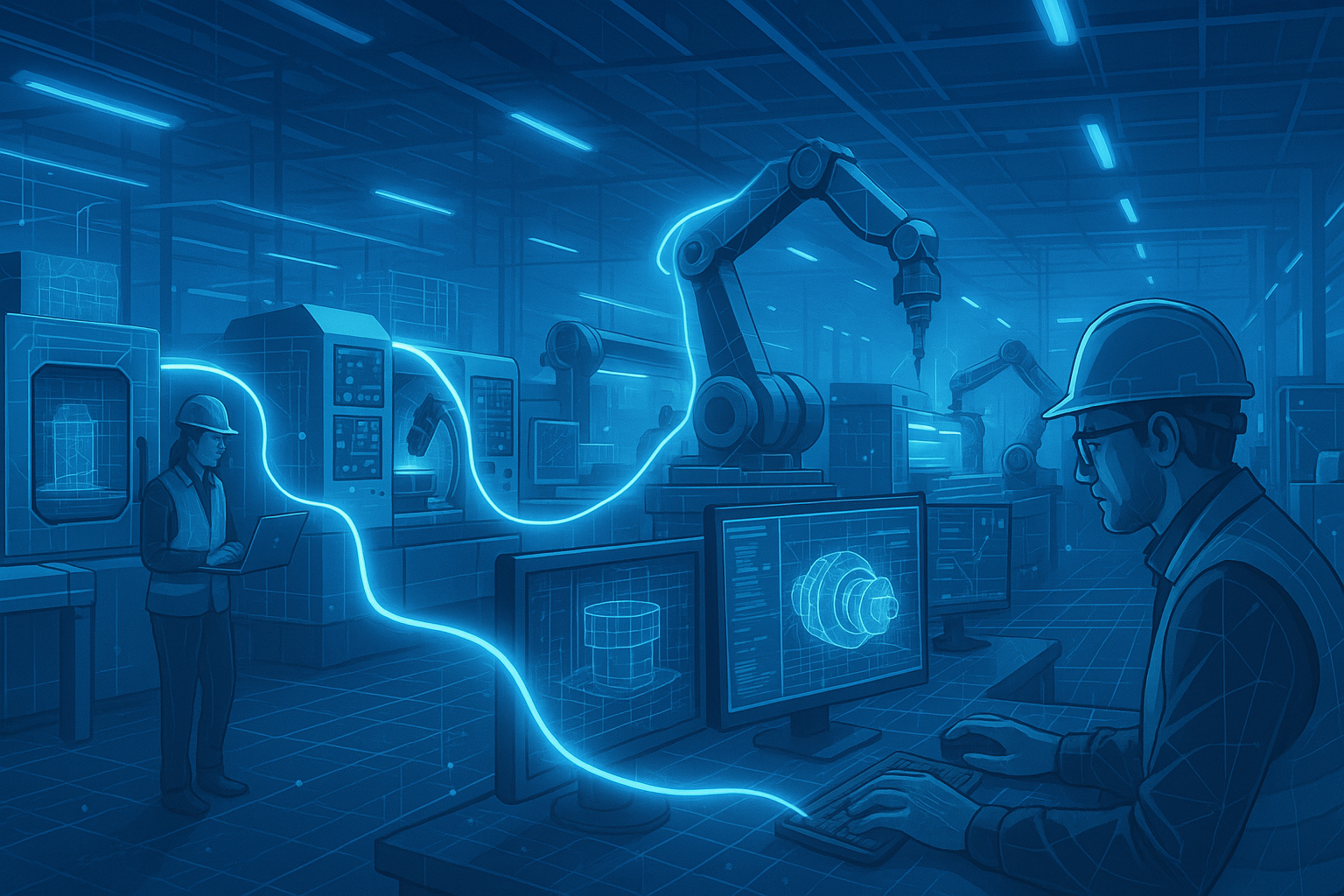
Best practices, pitfalls, and evolving strategies for implementing a Digital Thread in manufacturing.
Executive Alignment, Pilot Projects, and Early Digital Thread wins
Digital Thread, the end-to-end data backbone across a product’s lifecycle, is an essential differentiator for manufacturers aiming to lead in Industry 4.0. For companies looking to transition from disconnected systems to unified data flows, adopting best practices is both a strategic necessity and a competitive imperative. At its core, a successful Digital Thread links design, engineering, manufacturing, and supply chain stakeholders into a single source of operational truth, enabling superior collaboration, compliance, and rapid innovation. The journey begins with a solid cultural and executive commitment to enterprise-wide data sharing and Digital Transformation. Early wins often come from piloting the Digital Thread with a high-impact process—such as integrating CAD and PLM platforms (like Aras Innovator) to automate engineering change notifications and improve traceability. This can demonstrate measurable productivity jumps, decreased error rates, and faster approvals across departments. Bringing together ERP, PLM, and MES with modern integration practices helps break down data silos.
Manufacturing leaders are prioritizing open API solutions and modular software strategies that adapt to growth. Modernization should not overlook the importance of employee buy-in; transparent communication and user-friendly documentation ease the transition. Ultimately, establishing a Digital Thread is not a one-off IT project but a continuous Business Transformation journey. Organizations like NIST highlight the value of industry standards and continual benchmarking—resources are available at NIST Digital Thread for Manufacturing to frame your program’s metrics and resilience. For practical guidance see this article on Digital Threads for Sustainable Manufacturing.
Actionable Tips and Solutions for Overcoming Digital Thread Pitfalls and Roadblocks
Addressing Digital Thread pitfalls requires a blend of technical readiness and cultural alignment. First and foremost, legacy system integration stands as a significant hurdle; manufacturers must audit all existing software and hardware assets for compatibility, then prioritize replacements and upgrades according to risk and value. This is often referred to as a 'Fit-Gap Analysis'. Open architecture solutions like those offered by Aras Innovator are advantageous, as they enable smoother integrations with existing ERPs, CAD tools, and MES platforms, minimizing silos. Comprehensive data governance frameworks are vital—standardizing formats and cleansing data across systems to ensure a single source of truth throughout the lifecycle. Security and compliance are no less critical. Strategies must include robust access controls, encrypted communications, and regular system audits to mitigate data breaches and regulatory penalties. Organizational silos pose another persistent challenge, often requiring top-down mandates for cross-functional collaboration. Executive sponsorship is crucial for enforcing Digital Ownership and accountability. Change management plans should emphasize communication, ongoing user training, and continuous feedback loops so employees understand both the why and the how of new workflows. Another pitfall is vendor lock-in. To avoid this, opt for platforms emphasizing open APIs and data portability. OpenBOM provides a useful perspective on the dangers of closed data: Why Digital Thread Matters for Modern Manufacturing. Lastly, project scaling and continuity need roadmap planning from the outset, balancing quick wins with long-term vision—NIST's ongoing research is a prime resource for developing a resilient strategy: NIST digital thread research.
Technologies, KPIs, and Evolving Strategies for Digital Thread Leadership
True industry leaders regularly adapt their Digital Thread approaches as technology and business demands evolve. Emerging technologies like graph-based data management and advanced generative AI are now being explored to further unify data sources and create intuitive access to manufacturing intelligence; for example, AWS leverages graph databases for resilience and scalability (AWS Digital Thread for Manufacturing). KPIs for Digital Thread initiatives should include reductions in time to locate information, shorter engineering change cycles, improved traceability and audit readiness, and, ultimately, faster time-to-market. Periodic benchmarking—across similar manufacturers or industry groups—helps maintain a competitive edge. Continuous improvement also hinges on collecting user feedback and iteratively enhancing process designs. Holding regular Digital Thread review sessions and updating documentation ensure alignment with both new business processes and regulatory changes. Autodesk provides strong visual examples of how to design and maintain a single source of product truth (Unify Product Lifecycle Data). By regularly evaluating technologies, aligning teams, and adhering to best practices, manufacturers achieve resilient, scalable, and innovative digital thread environments. This approach not only delivers efficiency, but also supports a robust, future-proof manufacturing ecosystem.
