


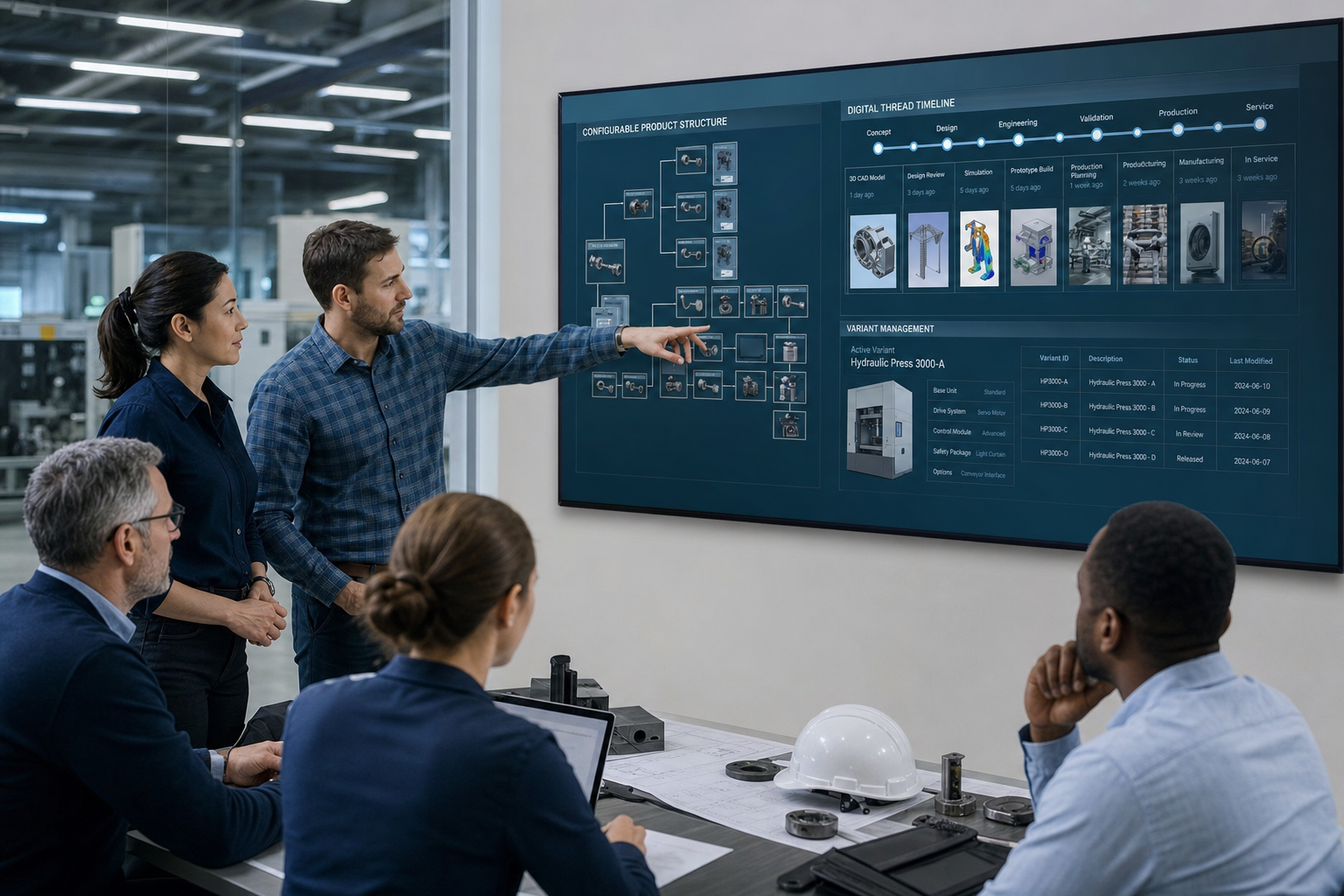
How disciplined Configuration Management strengthens the Digital Thread.
Why Configuration Discipline is Critical for the Digital Thread
Digital thread conversations often focus on systems and dashboards: which platforms to connect, how to visualize lifecycle data, and what analytics to run on top. For manufacturers that build complex, configurable products, that focus can be misleading. The real challenge is not just moving data between PLM, ERP, and MES; it is making sure the data you move is organized around controlled configurations. Without disciplined configuration management (CM), a digital thread simply moves inconsistent information faster from one silo to another. Configuration management is the discipline of defining, controlling, and tracking the functional and physical attributes of a product throughout its life. In a manufacturing context, that means being able to answer questions like: Which exact combination of modules, options, and software is installed on this unit? Which revision and configuration did we quote to this customer? How many customers are affected by a proposed design change? When CM practices are weak, those questions trigger time-consuming hunts through CAD models, spreadsheets, and emails—and different teams often arrive at different answers. For Intrepid’s ideal customers—engineer-to-order and complex industrial manufacturers—the stakes are even higher. Each order may represent a unique or highly configured variant. Mismanaging configurations leads directly to misquotes, rework, and warranty exposure. Modern PLM platforms such as Aras are designed to address this by combining traditional configuration management concepts with powerful variant and change control capabilities. Resources like Visure’s product configuration management guide emphasize that CM, PLM, and configuration lifecycle management (CLM) must work together to keep configuration logic consistent from engineering through operations (Visure guide to product configuration management). When CM is tightly integrated with your digital thread strategy, every major data object in the thread—requirements, CAD, BOMs, routings, software baselines, test results, as-built records—is linked back to clear configuration identifiers. That link is what turns the digital thread from a general integration exercise into a powerful tool for traceability and decision-making. It allows you to see not only which systems have information about a product, but exactly which configuration that information applies to, across its entire lifecycle.
CM as the Backbone of Traceability and Variants
When you view the digital thread through a configuration-management lens, traceability becomes much more concrete. Instead of a vague promise to “connect systems,” you are explicitly connecting configurations—linking each approved combination of parts, software, and parameters to the processes and evidence that prove it was built and tested correctly. This is why product configuration management and configuration lifecycle management are increasingly described as the backbone of the digital thread. Effective CM starts with precise definitions. You establish configuration items (CIs) that represent meaningful, controllable units such as product families, modules, and serialized assets. For each CI, you define which attributes are under configuration control and which are simply reference data. Visure’s overview of product configuration management lays out how PLM, PCM, and CLM fit together to provide a single source of truth for these relationships (Visure guide to product configuration management and CLM). In practice, this means that when engineering updates a configurable module in Aras, the system knows exactly which variants and customer orders could be affected. The digital thread then extends those controlled configurations into execution and feedback systems. A released configuration from Aras should drive derived, 100% BOMs and routings in Odoo and the shop floor, with clear effectivity dates or serial ranges. As orders are fulfilled, MES or production systems generate as-built records keyed by configuration and serial number. Quality systems collect nonconformance and test data against the same identifiers. Umbrex’s discussion of digital thread integration strategy illustrates how aligning PLM, MES, and ERP around shared identities turns the thread from a reporting concept into a practical execution tool (Umbrex digital thread integration strategy). Crucially, this approach also strengthens change management. When a change request is raised—for example, to substitute a component due to obsolescence—the CM discipline ensures that Aras can identify all impacted configurations, and that downstream systems only implement changes within approved effectivity windows. Odoo receives updated structures and planning data; the shop floor receives revised work instructions; service teams know which installed units require retrofit. Without disciplined CM at the center, these updates often roll out inconsistently, leaving some products in undocumented hybrid states that are difficult to support or certify. By making configuration items and rules first-class citizens in your PLM implementation, you transform the digital thread from a “system integration” project into an operational capability: the ability to state, at any moment, exactly what configuration each customer owns, how it was built, and which rules govern its evolution.
Practical Steps to Align CM, PLM, and Enterprise Systems
Turning configuration management into a practical enabler of the digital thread requires changes in process, tooling, and culture. Many organizations start from a place where configuration rules are dispersed across CAD models, spreadsheets, tribal knowledge, and ad-hoc scripts in ERP. The first step is to centralize that logic in a system designed to manage product structures and changes—typically PLM—then methodically connect it to the systems that consume and generate lifecycle data. On the process side, establish clear governance for configuration items and rules. Define who can propose new options, who approves them, and how conflicts are resolved when marketing, engineering, and operations have competing priorities. Align these processes with your engineering change workflows so that the introduction or retirement of configuration options is always accompanied by a controlled change package. Resources on configuration lifecycle management emphasize the importance of this governance in avoiding a proliferation of undocumented variants that erode margins and traceability (Visure overview of configuration lifecycle management concepts). From a tooling perspective, invest in integrations that keep configuration data synchronized between Aras PLM, Odoo ERP, and other enterprise applications. For Intrepid’s customers, that often means publishing 150% BOMs and configuration rules from PLM, then deriving 100% order-specific structures for execution while maintaining links back to the configurable master. Digital thread resources from IoT Digital Twin PLM stress that identity—stable identifiers and typed links—is the hard part of the thread, not the pipelines that move data (IoT Digital Twin PLM article on digital thread architecture). A configuration-centric thread leans into that principle by treating configuration IDs and serial numbers as the anchor points for all integrations. Culture and training close the loop. Engineers need to think in terms of product families and options rather than one-off BOMs; sales and estimating teams must learn to work within governed configuration rules rather than inventing new variants for every opportunity; operations teams must see the value of capturing as-built and nonconformance data against precise configuration identifiers. Intrepid can support this transition with workshops that map current-state practices, define target configuration flows, and pilot new processes on a representative product line. Over time, a strong configuration management discipline makes advanced initiatives like digital twins and predictive analytics far more effective. When you can trust that every twin, dataset, and dashboard is tied back to a well-controlled configuration, you spend less time reconciling data and more time improving products. In that sense, investing in CM is one of the highest-leverage steps manufacturers can take to strengthen their digital thread and unlock the full potential of their PLM and ERP platforms.
